n lecture we that nondisjunction can occur in meiosis Biology Diagrams In contrast, euploidy is when a cell contains the normal chromosome complement. Nondisjunction may occur any time a cell divides, so it can happen during mitosis, meiosis I, or meiosis II. Conditions associated with nondisjunction include mosaicism, Down syndrome, Turner syndrome, and Klinefelter syndrome.
Chromosomal Abnormalities If a zygote is formed from a gamete that has experienced a non-disjunction event, the resulting offspring will have extra or missing chromosomes in every cell of their body Conditions that arise from non-disjunction events include: Patau's Syndrome (trisomy 13) Edwards Syndrome (trisomy 18) Down Syndrome (trisomy 21) Klinefelter Syndrome (XXY) Turner's Syndrome

Nondisjunction Biology Diagrams
Study with Quizlet and memorize flashcards containing terms like Which of the following accurately describes a possible meiotic nondisjunction event?, All of the following events occur during normal meiosis except _______., T/F In order to create the possibility of generating a trisomy, nondisjunction must occur during meiosis II. and more.
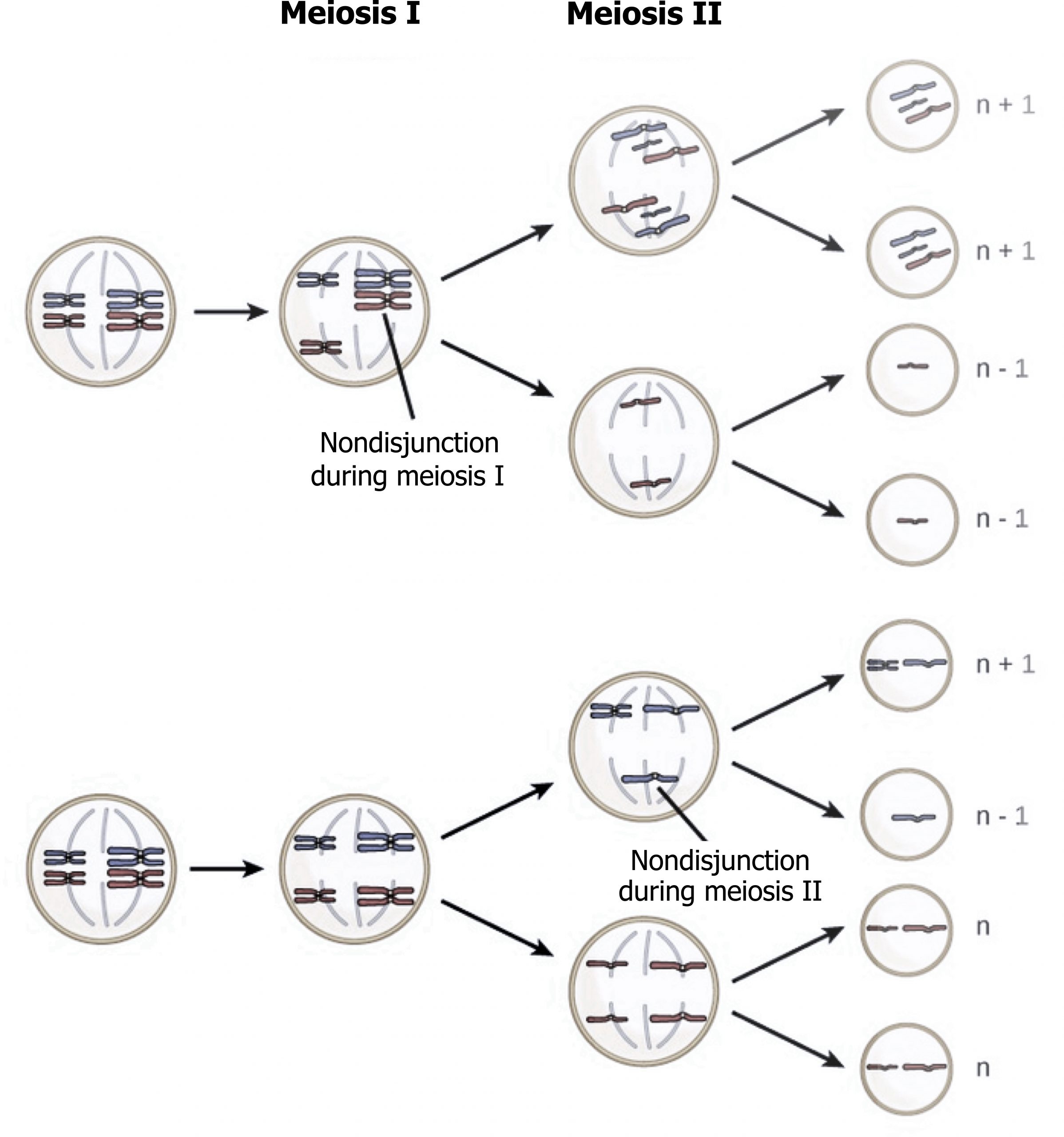
Nondisjunction occurs when chromosomes do not separate properly during cell division. This produces cells with imbalanced chromosome numbers.

CH 8,10 HW Flashcards Biology Diagrams
Nondisjunction: Let's explore the science behind how an offspring acquires the wrong number of chromosomes through a deleterious phenomenon during meiosis. Nondisjunction is a critical genetic event that results in an abnormal number of chromosomes in cells, leading to conditions known as aneuploidy or mosaicism. The following examples illustrate the various disorders associated with nondisjunction, providing insights into their underlying mechanisms and effects on individuals.